If your ERP retry logic lives in Magento cron jobs, you didn’t build a commerce platform. You built an integration engine that happens to have a checkout.
I’ve audited Magento projects where more than half the custom code had nothing to do with commerce. It was DTO mappings, SAP field transformations, order export queues, pricing sync retries, and stock reconciliation scripts — all living inside Magento modules, all running on Magento cron, all sharing the same runtime as the storefront.
The commerce platform became the integration platform. And that’s where things started breaking.
How Integration Logic Creeps In
Nobody sets out to make Magento their middleware. It happens gradually, driven by forces that make sense in the moment:
- Agency SOWs. The agency knows Magento. The SOW is for a Magento project. So the SAP integration gets built as a Magento module. Nobody scopes middleware separately because it’s “part of the project.”
- Platform capabilities. Magento has cron, queues (RabbitMQ or MySQL), observers, and a CLI. It looks like it can handle integration work. And it can — for the first integration. The fifth one is where it falls apart.
- Time pressure. Building a separate integration layer means another deployment pipeline, another runtime, another thing to monitor. When go-live is in 8 weeks, teams take the shortcut.
- Familiarity. The team knows PHP and Magento’s DI container. Writing an observer that calls an ERP API is familiar territory. Standing up a Go service or configuring MuleSoft is not.
Every one of these reasons is rational. And every one of them creates technical debt that compounds with every new integration.
What Goes Wrong
Coupling That Compounds
When your SAP order export is a Magento module, it depends on Magento’s service contracts, DI container, and data model. Every Magento upgrade becomes an integration upgrade too. I’ve seen teams skip two major Magento versions because their ERP integration modules couldn’t survive the upgrade — not because the commerce features changed, but because internal APIs shifted.
The integration code is now blocking your commerce platform from evolving.
Cron Becomes Your Orchestrator
Magento’s cron runner is a single-threaded scheduler. When you stack ERP exports, pricing syncs, stock updates, and order status checks on top of indexers and cache warming, you get contention. Jobs overlap, miss their windows, or silently fail.
I audited a project where a pricing sync from SAP ran every 5 minutes via cron. It processed 40,000 SKUs sequentially. When the SAP endpoint was slow, the job ran over into the next execution window. Two instances of the same job fought over the same data. Prices flickered between old and new values on the storefront for hours before anyone noticed.
Cron is a scheduler, not an orchestration engine. But in most Magento projects, it became one.
Retry Logic Becomes Business Logic
ERP integrations fail. APIs time out. Rate limits get hit. So teams build retry logic. In Magento, that retry logic lives inside commerce modules — next to cart rules, tax calculations, and catalog management.
Suddenly your order export module knows about exponential backoff, dead-letter queues, and circuit breakers. Your stock sync module has its own retry table with status columns and failure counters. Each integration reinvents the same patterns because there’s no shared infrastructure layer.
This is integration plumbing masquerading as commerce code. It makes every module harder to test, harder to debug, and harder to hand off to the next team.
DTO Transformations Pollute the Domain
Magento’s data model is not SAP’s data model. Every integration needs transformation logic: mapping Magento order entities to SAP sales documents, converting Magento product attributes to ERP material masters, translating customer groups to business partner categories.
When these transformations live inside Magento modules, they create a shadow data model. You end up with helper classes full of field mappings, conversion arrays, and format adapters — none of which have anything to do with commerce. But they’re loaded into Magento’s DI container, they’re part of your deployment, and they break when either side changes its schema.
The Boundary Model
The fix is a clear separation. Here’s what it looks like:
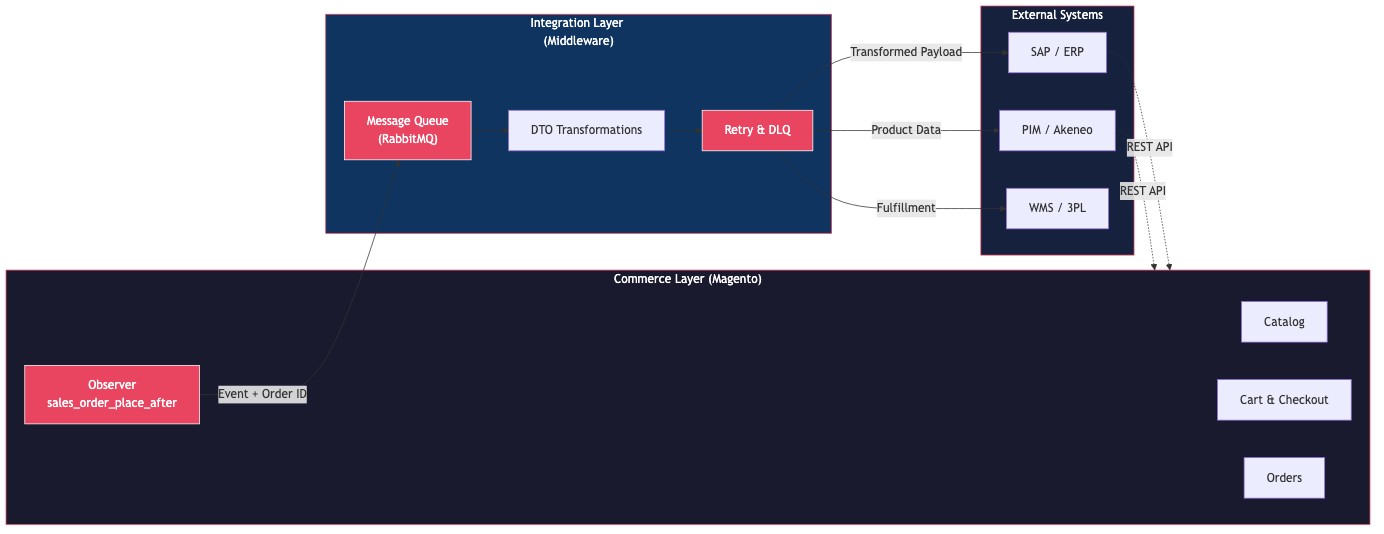
Commerce Layer (Magento): Catalog, cart, checkout, customers, orders, promotions. Magento owns the commerce domain. It emits events, serves APIs, and manages state.
Integration Layer (Middleware): DTO transformations, retry logic, queue management, routing, orchestration. This layer translates between Magento’s data model and external systems. It handles the messy, failure-prone work of connecting systems that were never designed to talk to each other.
External Systems (ERP/CRM/PIM/WMS): SAP, NetSuite, Dynamics, Akeneo, whatever. These are the systems of record for non-commerce data.
The integration layer is where the hard problems live — retries, idempotency, conflict resolution, schema mapping. These problems deserve their own runtime, their own deployment pipeline, and their own monitoring. They don’t belong inside Magento.
What This Looks Like in Practice
- Magento fires an observer on
sales_order_place_after. The observer publishes a lightweight message to RabbitMQ — just the order ID and a timestamp. No transformation, no API calls, no retry logic. - A middleware service picks up the message, fetches the full order via Magento’s REST API, transforms it into the ERP’s format, and pushes it to SAP. If SAP is down, the service handles retries with backoff. If the message fails permanently, it goes to a dead-letter queue.
- Magento never knows whether the ERP received the order. It doesn’t need to. The integration layer owns that responsibility.
This is the same pattern we use in the Golang series — Magento as a data source and event emitter, external services for the heavy lifting. Whether that middleware is a Go microservice, a Node.js worker, or an iPaaS like MuleSoft depends on your team and scale. The principle is the same: keep integration logic out of your commerce runtime.
Decision Checklist
Externalize when:
- The integration involves retry logic, backoff, or dead-letter handling
- You’re mapping between two different data models (DTO transformations)
- The job processes more than a few hundred records per run
- Failure in the integration should not affect the storefront
- You need to integrate the same external system from multiple channels (not just Magento)
- The integration logic changes independently of commerce logic
Keep in Magento when:
- It’s a simple webhook — fire and forget, no retries needed
- The integration is tightly coupled to a commerce event and runs inline (e.g., real-time tax calculation during checkout)
- You have one integration and no plans for more
- The team genuinely cannot support a second runtime today (but plan for it)
Be honest about the last point. “We can’t support middleware” is a valid constraint today. It’s not a valid architecture forever.
The Leadership Question
As a tech lead, the question is not “Can Magento handle our SAP integration?” — it can, technically. The question is: “What happens to our upgrade path, our debugging experience, and our team velocity when every external system is wired directly into our commerce platform?”
Integration logic inside Magento creates a hidden cost. Every new integration makes the platform harder to upgrade, harder to scale, and harder to hand to a new team. You’re not saving time by keeping it in Magento — you’re borrowing time from your future self.
The teams I’ve seen succeed with complex integrations are the ones that drew the boundary early. They let Magento be a commerce platform. They built (or bought) an integration layer. And they treated the interface between them — REST APIs, message queues, event contracts — as a first-class architectural concern.
Draw the Line
Your commerce platform should do commerce. Your integration layer should do integration. The moment these two concerns share the same codebase, the same cron runner, and the same deployment pipeline, you’ve created a system that’s harder to change in every direction.
The line between them is not a nice-to-have. It’s the architecture.