AI recommendations are not agentic commerce. Here’s what actually is.
Every commerce platform now has an “AI-powered” badge somewhere. Shopify has Sidekick. Adobe Commerce has Sensei. Third-party tools offer AI-driven product recommendations, search ranking, and email personalization. And most of it is the same pattern: a model takes input, produces a suggestion, and a human (or a rule) decides what to do with it.
That’s not agentic. That’s assisted.
Agentic commerce is something different — and the distinction matters if you’re making architecture decisions today that need to hold up in two years.
What “Agentic” Actually Means
An agentic system doesn’t suggest. It acts. It has a goal, observes the environment, makes decisions, and executes — with varying degrees of autonomy. The key difference from traditional AI features:
- AI feature: “Customers who bought X also bought Y” → displayed as a widget. A human designed the placement. A rule decides the fallback. The model is a component.
- Agentic system: An agent monitors cart abandonment in real time, decides which customers to target, selects the optimal discount strategy per customer, generates the message, sends it through the best channel, and adjusts based on results — without a human approving each step.
The first is a feature. The second is a system with goals, perception, decision-making, and action. That’s the distinction.
The Spectrum, Not a Switch
Agentic isn’t binary. It’s a spectrum:
- Rule-based automation. If cart > $500, show free shipping banner. No AI involved.
- AI-assisted decisions. Model recommends products. Human or rule decides placement and timing.
- AI-driven actions. Model decides what to show, when, and to whom. Human sets guardrails.
- Autonomous agents. Agent pursues a goal (maximize conversion, reduce support tickets) with minimal human intervention. Adjusts strategy based on outcomes.
Most commerce platforms today are at level 2. The jump to level 3-4 is where the architecture changes fundamentally.
Why This Matters Now
Three forces are converging:
LLMs changed the interface. Before GPT-scale models, AI in commerce meant recommendation engines and A/B testing frameworks. Now you can build agents that understand natural language queries, generate dynamic content, and reason about customer intent. The toolbox expanded overnight.
Customer expectations shifted. B2C customers now expect conversational search, not keyword matching. B2B buyers want “reorder what I bought last quarter for the Chicago warehouse” to just work. The gap between what customers expect and what traditional commerce platforms deliver is widening.
Platform APIs are ready. Both Adobe Commerce and Shopify now expose enough surface area — APIs, webhooks, events — to build agentic layers around them. You couldn’t do this practically five years ago. You can now.
What Agentic Commerce Looks Like in Practice
Forget the theoretical. Here are concrete patterns that are buildable today:
Intelligent Search Beyond Keywords
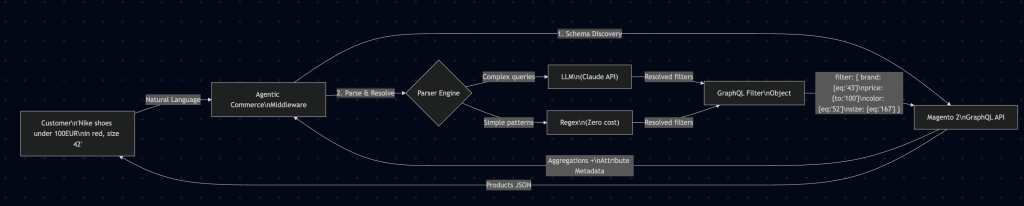
Traditional commerce search: customer types “blue running shoes size 10”, the platform matches keywords against product attributes. Agentic search: customer types “something comfortable for a marathon in hot weather”, an agent interprets intent, considers product attributes that aren’t in the query (breathability, weight, reviews mentioning heat), and returns results ranked by inferred need — not keyword match.
Dynamic Bundling
A customer adds a camera to their cart. Instead of showing “frequently bought together” (a static model), an agent evaluates the customer’s purchase history, current cart, browsing behavior, and margin data to construct a personalized bundle — memory card, specific lens, case that fits this model — with a price point optimized for conversion likelihood.
Autonomous Inventory Rebalancing
An agent monitors sell-through rates across warehouses, detects that a product is trending in the Southwest region but overstocked in the Northeast, and initiates a transfer recommendation — or executes it directly if authorized. No human reviews a spreadsheet. The agent has a goal (minimize stockouts while controlling transfer costs) and acts on it.
Proactive Customer Service
Instead of waiting for a customer to open a support ticket about a delayed shipment, an agent detects the delay from carrier data, assesses the customer’s value and order history, decides on the appropriate response (proactive email, discount on next order, expedited reshipping), and executes — before the customer even notices the problem.
The Platform Lens
On Adobe Commerce
Adobe Commerce has the deeper extension model. You can build agentic layers that hook into:
- Observers and plugins for real-time event capture (order placed, cart updated, customer logged in)
- REST and GraphQL APIs for data access and action execution
- RabbitMQ / message queues for async event processing
- Adobe Sensei as a baseline recommendation engine to augment (not replace)
The architecture pattern: Magento stays the commerce engine. An external agentic layer — built in Python, Go, or Node — subscribes to Magento events, processes them through LLM-based decision models, and pushes actions back via API. Magento doesn’t know it’s being orchestrated. It just processes API calls as it always does.
The challenge with Adobe Commerce: the platform is heavy. Every API call has latency. Real-time agentic actions (sub-second personalization during page load) require caching strategies and pre-computed decisions. You can’t call GPT-4 on every page view.
On Shopify
Shopify’s constraints actually force better agentic architecture:
- Webhooks for event-driven triggers (order created, checkout updated, product changed)
- Storefront API + Hydrogen for custom frontend experiences the agent can control
- Shopify Functions for discount logic, validation, and fulfillment rules that run server-side
- App extensions for embedding agent-driven UI into the admin and storefront
The architecture pattern: a separate agentic service receives Shopify webhooks, makes decisions, and pushes changes back via the Admin API or Storefront API. Shopify Functions handle the commerce-side logic (apply the discount the agent decided). Hydrogen gives the frontend flexibility to render agent-driven experiences.
The advantage: Shopify’s opinionated, API-first model means there’s less temptation to shove agent logic into the platform. The disadvantage: less flexibility in core commerce behavior. You can’t override checkout flow the way you can in Magento.
What You Actually Need to Build This
Let’s be honest about what’s required. This isn’t a weekend project.
Infrastructure: – A separate runtime for the agentic layer (Python/Go/Node service, not inside the commerce platform) – Message queue or event bus (RabbitMQ, Kafka, or even Redis Streams) for event-driven communication – An LLM API (OpenAI, Anthropic, or self-hosted) for natural language understanding and decision-making – Vector database (Pinecone, Weaviate, pgvector) if you’re doing semantic search or RAG
Data: – Customer behavior data (browsing, purchase history, search queries) — structured and accessible – Product data enriched beyond basic attributes (descriptions, reviews, specifications parsed into embeddings) – Feedback loops: you need to measure outcomes to improve agent decisions
Team skills: – ML/AI engineering (prompt engineering at minimum, fine-tuning if you’re serious) – Integration architecture (the agentic layer is middleware — same patterns as ERP integration) – Commerce domain knowledge (an agent that doesn’t understand cart rules, tax, and inventory is useless)
Guardrails: – Rate limits on agent actions (an agent that sends 10,000 discount emails in a loop is a liability) – Human approval gates for high-impact decisions (pricing changes above threshold, bulk inventory moves) – Audit trail for every agent decision and action – GDPR/privacy compliance for personalization data
If you don’t have at least the infrastructure and data foundations, you’re not ready for agentic commerce. You’re ready for better AI features — and that’s fine. Start there.
Decision Checklist: AI Feature vs. Agentic System
Build an AI feature when: – The use case is well-defined (product recommendations, search ranking) – The action is low-risk (showing a widget, sorting results) – Human review of outputs is feasible – You need results in weeks, not months – The team has no ML infrastructure experience
Build an agentic system when: – The use case involves multi-step decisions (detect → decide → act → measure) – Speed matters — human-in-the-loop is too slow for the use case – The system needs to adapt based on outcomes, not just rules – You’re willing to invest in guardrails, monitoring, and feedback loops – The potential ROI justifies the infrastructure cost
Don’t build either when: – Your product data is a mess (fix the catalog first) – You can’t measure the outcome you’re optimizing for – “AI” is the goal, not the tool
The Leadership Angle
If you’re a tech lead or CTO evaluating agentic commerce, the question isn’t “Should we add AI?” — everyone will. The question is: Are we building features or systems?
Features are faster to ship, cheaper to maintain, and easier to explain to stakeholders. They solve specific problems. Most teams should start here.
Systems are harder to build, require more infrastructure, and create organizational complexity. But they compound. An agentic system that learns from outcomes gets better over time. A static recommendation widget doesn’t.
The mistake I keep seeing: teams that skip the “AI feature” phase and jump straight to “autonomous agent” because it sounds more impressive. They end up with a complex system that doesn’t work, instead of a simple feature that does.
Start with features. Prove the value. Build the infrastructure. Then let the agents loose — with guardrails.
The Real Starting Line
Agentic commerce is not a product you buy. It’s an architecture you build — layer by layer, on top of a commerce platform that does its job well.
Whether that platform is Adobe Commerce or Shopify, the pattern is the same: the commerce engine handles commerce. The agentic layer wraps around it — observing, deciding, acting. The boundary between them is an API, a webhook, a message queue. Not a plugin. Not a module. Not “AI built in.”
The teams that get this right will build commerce experiences that adapt and improve autonomously. The teams that don’t will keep adding recommendation widgets and calling it AI.
The difference is architecture.