Executive summary
TL;DR
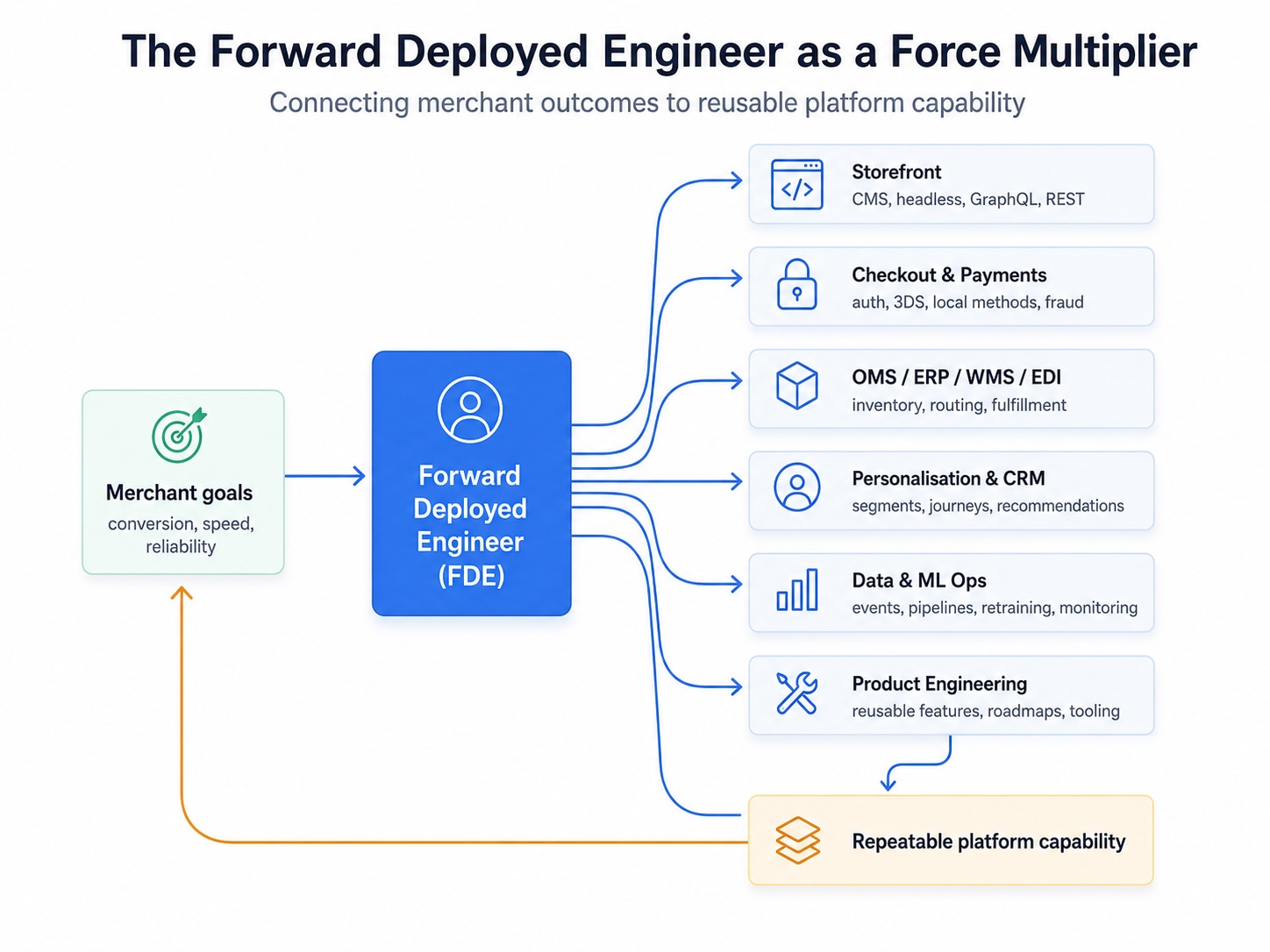
- In e-commerce, “Forward Deployed Engineer” is best understood as a deployment model, not just a title: an engineer works close to merchants, partners, or enterprise users, solves hard production problems in context, then turns those learnings into reusable platform capability. That is the core pattern described by Palantir and, more explicitly in commerce infrastructure, by Stripe.
- The exact title is inconsistent across commerce companies. Stripe uses Forward Deployed Engineering directly, but Shopify, Adyen, commercetools, Bloomreach, and Klaviyo expose the same function through titles such as Solution Engineer, Solutions Architect, Implementation Engineer, and Expert Services Architect.
- The role becomes most valuable at the messy seams of commerce: headless storefronts, payments and checkout, OMS/EDI/ERP/WMS integration, omnichannel personalisation, customer data unification, and ML-backed recommendation systems.
- The strongest versions of the role are engineering-led, user-facing, and product-shaping. They are not support desks and not glorified professional services: they are closest to a hybrid of senior engineer, architect, and field product thinker.
- The best KPI set is two-layered: one layer measures merchant and commerce outcomes such as conversion, authorisation rate, launch speed, reliability, and campaign efficiency; the other measures platform leverage such as repeatable assets, quality of handoff, and roadmap influence.
- For engineering leaders, the key risk is clear: if field work never becomes product, you are building a services business; if field work continuously hardens the platform, you are building an advantage. That productisation loop is explicit in Palantir’s model, explicit again in Stripe’s FDE job design, and echoed in current venture analysis of why FDEs are expanding now.
Bottom line
The FDE role is already present in e-commerce, but usually under different names. Today’s commerce leaders should treat it as a strategic capability for high-complexity accounts and high-change architecture, especially where teams need to shorten time-to-value without losing architectural discipline.
Definition and origin
A practical definition comes from Palantir’s long-running description of the role: a Forward Deployed Software Engineer embeds directly with customers, configures existing platforms, implements solutions with end users, and combines software development, data engineering, customer engagement, and problem-solving. Palantir contrasts this with traditional software engineering, which builds one capability for many users; the FDSE instead enables many capabilities for one customer.
That model has now spread far beyond Palantir. In 2026, a16z described startups copying the pattern of embedding forward-deployed engineers with customers, building customised workflows, and productising what they learn, explicitly calling it a model Palantir pioneered in the early 2010s. 84.51°, a retail data science and media company, likewise states that the term FDE was coined by Palantir and describes a similar embedded model inside platform teams helping application teams through migrations and new-pattern adoption.
Why this matters in commerce is straightforward. E-commerce systems are rarely “pure product” environments. They sit at the intersection of catalogue, pricing, checkout, payments, tax, fraud, OMS, WMS, ERP, CRM, CMS, search, recommendations, analytics, and market-specific regulation. Shopify’s enterprise architecture guidance frames modern commerce architecture as the alignment of commerce platforms with systems such as ERP and CRM to make change faster and lower-risk. In practice, the gap between “the platform” and “the merchant’s actual estate” is exactly where forward-deployed work appears.
A useful modern refinement comes from Stripe. Its current Forward Deployed Engineering team says the role exists to solve the hardest problems complex enterprise users face and turn those solutions into platform capabilities that scale to everyone. Stripe also makes two important boundary statements: first, “this is not a support function”; second, the team is building reusable frameworks and blueprints, not one-off fixes. That is the clearest contemporary statement of what the role has become in commerce infrastructure.
How the role appears in e-commerce today
The single biggest discovery from current official sources is this: in e-commerce, the function is common but the title is fragmented. Stripe uses the FDE label directly. Most other major commerce firms do not. Instead, they place the same embedded, technical, user-facing work under solutions engineering, solution architecture, implementation, launch, or expert services.
| Company | Public role pattern | What the role does in practice | What this signals about FDE in commerce |
| Stripe | Backend Engineer, Forward Deployed Engineering | Works with strategic enterprise users, across Revenue Suite and Payments, provides architectural guidance, resolves complex technical issues, builds reusable integrations and blueprints, and feeds gaps back into product strategy. | The purest current commerce-infrastructure version of FDE |
| Shopify | Solutions Engineer / Solutions Architect | Advises enterprise retailers on storefront development, GraphQL and REST integrations, B2B modernisation, and partner ecosystems involving search, personalisation, ERP, CMS, subscriptions, and fraud. | Same role pattern, but framed around merchant and partner enablement rather than the FDE label |
| Adyen | Implementation Engineer / Solutions Engineer | Acts as primary contact for merchant technical teams through design, development, testing, and launch; works across e-commerce, marketplaces, POS, and issuing; collaborates with Sales, Product, Engineering, and Account Management. | Payments-focused FDE under implementation language |
| commercetools | Solution Architect / Expert Services | Accelerates implementation and time-to-value through architecture review, migration strategy, developer onboarding, workshops, launch planning, performance review, and ongoing innovation guidance. | A launch-and-architecture-centric FDE model for composable commerce |
| Bloomreach | Solutions Architect / Professional Services Architect | Designs solutions, codifies best practice, works across departments, and gets directly involved in client implementations, including AI-driven product discovery and composable commerce frameworks. | Personalisation/search FDE pattern in professional services form |
| Klaviyo | Senior Pre-Sales Solutions Engineer | Runs discovery, designs pragmatic solutions, talks to both developers and marketers, hands work to implementation and Customer Success, and feeds segment needs back to Product and GTM. | Commercial/front-of-funnel variant of the same embedded engineering pattern |
The most useful leadership takeaway is this: commerce companies do not need to name the role FDE for the function to exist. The function appears wherever a company needs engineers who can move from merchant context to technical design to implementation to platform feedback loops without dropping ownership.
Responsibilities, deliverables, and stack
In e-commerce, the role is most visible where off-the-shelf product boundaries run into real-world variation. Official sources point to a repeatable responsibility map across the commerce stack.
| Commerce domain | Typical FDE work | Typical deliverables | Evidence |
| Platform and architecture | Assess current/future-state architecture; align commerce platform with ERP, CRM, CMS, tax, localisation, and data systems; evaluate patterns and migration paths | Reference architecture, integration blueprint, migration plan, environment setup, pattern reviews | Shopify enterprise architecture guidance; commercetools technical onboarding and expert services. |
| Storefront and headless | Design decoupled or headless storefronts; connect custom front ends to platform services; balance flexibility with operational safety | Storefront API integration, CMS split, performance and caching patterns, API contracts | Shopify documents that Storefront API connects custom fronts to core commerce services, and solution engineering at Shopify explicitly spans headless storefronts plus GraphQL/REST integration. |
| Payments and checkout | Improve authorisation, checkout UX, multi-currency and local methods, 3DS handling, fraud controls, reconciliation, and multi-product billing/payment flows | Checkout redesign, payment integration design, auth-rate playbooks, integration test plans, launch runbooks | Stripe customer stories and Stripe FDE job scope; Adyen implementation roles. |
| Logistics and post-purchase | Integrate OMS, EDI, WMS, inventory, freight, and routing logic with the commerce layer | Order orchestration flows, EDI-OMS mapping, automated routing rules, operational dashboards | Shopify’s cloud OMS / EDI guidance; commercetools solutions architect biography referencing OMS, WMS, inventory, and B2B. |
| Personalisation and CRM | Unify customer and product data; configure recommendation, segmentation, lifecycle journeys, and campaign automation | Audience model, recommendation rules, dynamic content templates, omnichannel journey maps, measurement plan | Bloomreach case studies and solutions architect profiles; Klaviyo positioning around first-party data and ecommerce platforms. |
| Data pipelines and ML ops | Build ingestion, validation, retraining, serving, monitoring, and feedback loops for recommendations and predictive systems | Event pipelines, training datasets, model retraining schedules, APIs for recommendations, validation and drift monitoring | AWS retail personalisation guidance and Google MLOps / recommendation architectures. |
The stack reflected in current official material is also unusually broad. On the commerce side, Shopify’s enterprise materials and author profiles point to Storefront API, GraphQL, REST APIs, and custom storefront models. Adyen and Klaviyo emphasise APIs, front-end development, data integrations, and webhooks. Stripe’s commerce customer stories and FDE role show work across Payments, Checkout, Invoicing, and multi-product financial flows.
On the data and ML side, AWS’s retail personalisation guidance uses Athena Federated Query, S3, Amazon Personalize, AppSync GraphQL endpoints, ECS/Fargate microservices, DynamoDB, EventBridge, Step Functions, CloudWatch, IAM, and MLOps orchestration. Google’s retail recommendation and MLOps documents point to Dataflow, BigQuery, Cloud Run, Vertex AI, Gemini, CI/CD/CT pipelines, data validation, model validation, monitoring, and automated retraining.
What that means in practice is simple: the commerce FDE is usually full-stack in scope, even when not full-stack in coding. The role needs enough depth to reason about distributed systems, APIs, data models, integrations, and operational behaviour, and enough breadth to understand merchant workflows, lifecycle marketing, fulfilment, and revenue mechanics.
Org fit, skills, metrics, careers, and compensation
There is no single “correct” reporting line for this role in commerce. Current sources show three durable homes. First, the role may sit inside product engineering, as Stripe’s FDE team does. Second, it may sit in enterprise, partner, or go-to-market solutions, as at Shopify and Klaviyo. Third, it may sit in expert services or professional services, as at commercetools and Bloomreach. Palantir’s careers material also frames Deltas as part of the Business Development organisation, which is a reminder that the model has always straddled technical delivery and commercial outcomes.
The hiring bar is consistently high. Stripe asks for backend depth, scalable systems design, API design, data modelling, direct user engagement, and willingness to travel. Adyen wants APIs, front-end development, integrations, project management, and strong merchant focus. Klaviyo wants practical solution design, adaptability, and fluency across developers and marketers, with specific comfort around APIs, webhooks, and e-commerce or marketing platforms. Shopify’s public author profiles for solution engineers add deep storefront and integration expertise across GraphQL, REST, search, personalisation, ERP, CMS, subscriptions, and fraud.
The most useful way to measure the role is with a balanced scorecard instead of a single vanity metric. For launch and delivery, official sources repeatedly emphasise time-to-value, technical win rate, quality of handoff, and repeatable assets. For commerce outcomes, the relevant measures are authorisation rate, payment success rate, checkout conversion, campaign creation time, open rate, incremental revenue, or other hard operational lifts. For platform health, the credible measures are uptime, incident response, observability, throughput readiness, MLOps automation, data/model validation, and monitoring against drift or failure.
The comparison below is an interpretive synthesis grounded in official role descriptions from Palantir, Stripe, Shopify, Adyen, commercetools, and Klaviyo. Some cells are therefore analytical rather than verbatim.
| Role | Core mission | Typical output | Relationship to users | Relationship to code | Best KPI |
| Forward Deployed Engineer | Solve user-specific technical problems and turn them into reusable platform capability | Architecture, integrations, production changes, blueprints, migration unblockers | Deep, direct, continuous | Usually hands-on and production-adjacent | Time-to-value plus reusable product leverage |
| Traditional SWE | Build durable product/platform capability for many users | Services, infra, features, libraries, internal platforms | Usually indirect | Deepest code ownership | Reliability, velocity, cost, quality |
| Solutions Architect | Design the right architecture and integration approach | Reference architectures, workshops, pattern reviews, adoption plans | High-touch, advisory | May prototype, but usually lighter coding | Technical win, architecture quality, adoption |
| Customer-facing PM | Align stakeholders, scope outcomes, sequence delivery | Requirements, priorities, governance, handoffs, rollout comms | Deep, often multi-threaded | Usually indirect | Delivery confidence, stakeholder alignment, outcome adoption |
Career paths are not standardised enough to state a universal ladder, but the evidence supports a strong inference: the role naturally feeds into senior/principal solutions architecture, platform or product engineering leadership, domain-specialist technical leadership in payments or commerce architecture, and in some cases product leadership, because the job repeatedly combines user discovery, architecture judgement, implementation detail, and roadmap feedback. Stripe explicitly wants someone who “thinks like a product person”, while Palantir and Klaviyo both stress the loop back into product and business teams.
Compensation is harder to normalise because official postings disclose local, not global, ranges, and titles vary. The safest reading is to treat current published pay as a set of market signals, not a fake single global band:
| Role snapshot | Published base range | Geography in posting | Source |
| Stripe Backend Engineer, Forward Deployed Engineering | CA$172,000–CA$258,000 | Canada | |
| Adyen Implementation Engineer | $105,000–$185,000 | Toronto | |
| Klaviyo Senior Pre-Sales Solutions Engineer | €80,000–€120,000 | EMEA commercial team |
The broad signal is that engineering-heavy, customer-facing commerce roles pay like senior technical roles, not like classic support roles, and they often add bonus, equity, or OTE on top of base. But any “single range” beyond these official disclosures would be less rigorous than the evidence justifies.
Case studies and operating risks
Several official cases show the role’s effect most clearly when it is viewed through outcomes.
A payments-heavy example comes from Chow Sang Sang, where Stripe’s professional services team ran in-depth workshops, designed the payment integration, accelerated launch, and helped deliver a 20% increase in authorisation rates, alongside better fraud handling and multi-currency support. The company explicitly said the integration would likely not have been completed without direct support and implementation guidance.
A unified-commerce example comes from BSH Home Appliances and commercetools. During the transformation of its global headless commerce platform, an architect from commercetools Expert Services supported key architectural decisions, including checkout and payment flows and the base setup for unified commerce. BSH’s rollout design is especially instructive: development teams were organised by capabilities such as checkout, payment, and APIs, while rollout teams worked with local business units on configuration, training, KPIs, and access management. The programme targeted 70 brand websites across 28 countries.
A personalisation example comes from JD Sports, where Bloomreach’s Loomi AI unified data and omnichannel engagement across markets. The reported outcomes included a 65% increase in conversion rate in the UK and a 75% uplift in open rates in Spain. The case matters because it shows the FDE-shaped problem in modern commerce: not just building a model, but wiring data, channels, segmentation, recommendations, and campaign execution into a scalable operating system.
An efficiency example comes from Desigual, where Bloomreach helped a three-person marketing team reduce campaign creation time by 75% and manage 80+ personalised campaigns across 72 countries. This is not “just martech”; it is what happens when technical enablement, data unification, templating, and platform design remove coordination cost from a commerce team.
These cases also expose the main operating risks.
The first risk is the bespoke trap: solving every customer problem as a new project. Stripe’s FDE team explicitly pushes against this by telling engineers to build reusable solutions, not one-off fixes. Palantir says valuable product additions originated in the field when FDSEs fed their configuration work back into the platform. This is the central mitigation strategy: require every field engagement to leave behind patterns, automation, playbooks, or product backlog changes.
The second risk is legacy and dependency drag. Shopify’s enterprise guidance argues that architecture must connect business goals to systems and data in a way that makes change repeatable. BSH’s transformation story adds the practical answer: capability-aligned development teams, autonomous rollout teams, and architectural support at the checkout/payment seam. In other words, the FDE function works best when it has a clear path from diagnosis to rollout, not when it is dropped into an unowned transformation.
The third risk is peak-load fragility. commercetools’ current Black Friday/Cyber Monday guidance is refreshingly concrete: use caching and observability, ramp up concurrency gradually, test for higher throughput, add exponential backoff and retry logic, and stagger large sync processes. In many commerce organisations, the FDE is the person who turns those best practices into environment-specific action before revenue-critical events.
The fourth risk is ML technical debt. Google’s MLOps guidance is blunt: the hard problem is not training a model offline, but building an integrated ML system and operating it continuously in production. That means data validation, model validation, deployment pipelines, monitoring, retraining, and protections against drift. AWS’s retail guidance complements this with a prescriptive architecture for ingestion, recommendation serving, orchestration, and monitoring. In commerce personalisation, this is increasingly part of forward-deployed work.
Hiring, onboarding, and comparison guidance
The clearest hiring rule from the current evidence is this: hire engineers, not presenters. Stripe’s FDE role is explicit that the job requires scalable systems thinking, API design, data modelling, and direct work with users. Adyen wants hands-on technology and integration depth. Shopify’s public solutions-engineering profiles highlight storefront and integration expertise, not slideware. If a candidate cannot reason about both production architecture and merchant workflow, they are usually a different role.
For e-commerce specifically, strong hiring profiles usually combine three forms of depth. First, technical depth in APIs, distributed systems, data, and debugging under load. Second, commerce domain depth in checkout, fulfilment, catalogue, B2B flows, fraud, personalisation, or omnichannel operations. Third, customer depth: discovery, communication with technical and non-technical stakeholders, and comfort operating in ambiguity. Klaviyo’s official requirements are particularly explicit on that third category.
Onboarding works best when it avoids generality. The most practical pattern is to assign the new hire a single high-value seam in the first phase: for example checkout and payments, OMS/EDI, or personalisation and data activation. commercetools’ expert-services model is notable here because it formalises architecture review, migration strategy, developer onboarding, environment setup workshops, launch planning, and technical working sessions. That is closer to a real onboarding operating model than most engineering job descriptions ever reveal.
A disciplined onboarding sequence for commerce FDEs should produce four artefacts early: a current-state architecture map, a gap register, a reference architecture or blueprint, and at least one reusable asset such as a connector, checklist, pattern, or runbook. That recommendation is an inference, but it is strongly supported by what the official roles repeatedly emphasise: architecture review, launch planning, pattern libraries, handoff quality, repeatable assets, and field feedback into product.