Introduction:
AI-driven shopping experiences are rapidly transforming how consumers discover and buy products. To stay at the forefront, Google has introduced the Universal Commerce Protocol (UCP) – an open-source standard developed with partners like Shopify, Etsy, Wayfair, Target, and Walmart[1]. UCP is designed to power the next generation of agentic commerce, where AI assistants can handle the entire shopping journey – from product discovery and recommendations to checkout – all within a conversational or search context[2]. By providing a common language and set of commerce primitives, UCP allows consumer-facing AI “agents” (such as Google’s AI Mode in Search or the Gemini AI app) to seamlessly interact with retailers’ backends in a standardized, secure way[3][4]. This article delves into what UCP is, how it works, and why it matters from both a technical and strategic perspective.
What is the Universal Commerce Protocol (UCP)?
At its core, UCP is an open standard for commerce interoperability. It establishes uniform APIs and schemas so that any AI-powered service (an “agent”) can connect to any business’s commerce system without bespoke integrations[5][6]. In other words, instead of each retailer building custom adapters for each AI platform or chatbot, UCP provides one universal interface compatible with multiple communication methods (REST APIs, Agent-to-Agent messaging, or even context injection into large language models)[7]. UCP works alongside existing standards – it’s compatible with the Agent2Agent (A2A) protocol for agent communication, the Agent Payments Protocol (AP2) for payments, and the Model Context Protocol (MCP) for LLM interactions[8]. Google and its partners have open-sourced UCP (see [ucp.dev][43]) and are inviting the developer community to help evolve it as a community-driven standard[9].
Designed for the whole ecosystem: Google emphasizes that UCP is built to benefit all players in the commerce ecosystem, not just Google’s own services[10][11]:
- Businesses (Retailers) – Integrate once and showcase products on any UCP-enabled surface (e.g. AI chat in Google Search, Gemini app). You retain control: you own your business logic and remain the Merchant of Record, and UCP even supports an “embedded” option to plug in your own checkout UI if desired[12].
- AI Platforms & Agents – Easily onboard many merchants via a standard set of commerce capabilities. UCP’s shared schema means an AI assistant can query inventory, prices, etc. in real time without custom adapters, and businesses have flexibility to use whichever agent frameworks or protocols (MCP, A2A, etc.) they prefer[13].
- Developers – UCP is open-source and extensible. It’s intended to be an evolving standard shaped by the developer community. Google has provided SDKs and sample servers to help developers “build the next generation of digital commerce” on top of UCP[9].
- Payment Providers – UCP uses a modular payment handler design. Different payment processors (Stripe, PayPal, Google Pay, etc.) can plug in, enabling universal payments with user choice. Every payment authorization in UCP carries cryptographic proof of user consent, leveraging AP2 for secure, tokenized transactions[11].
- Consumers – When brands adopt UCP, it removes friction from discovery to purchase. Shoppers can go from asking an AI for a recommendation to checking out in one flow. They get the best of both worlds: the convenience of conversational shopping and the confidence of buying directly from the merchant (with their member benefits, loyalty rewards, etc. honored)[14].
In short, UCP is aiming to be a “universal translator” between AI-driven consumer experiences and the diverse world of retail systems. It is not a Google-specific API, but a proposed industry standard so that “AI agents can execute shopping transactions across platforms without unique integrations”[15]. This collaborative approach (endorsed by 20+ global companies including Mastercard, Visa, Stripe, Adyen, Best Buy and more[1][16]) suggests broad interest in a common protocol for the emerging era of AI commerce.
How UCP Works: Architecture and Flow
Architecture & Capabilities: UCP defines a set of commerce capabilities – modular building blocks representing actions like product search, adding to cart, checkout, applying discounts, order tracking, etc.[17]. Businesses decide which services and capabilities they support (for example, a retailer might implement the “Shopping” service with capabilities for product discovery, checkout, discounts, fulfillment, etc.). Each capability is described by a standard schema and can be extended with optional features. For instance, a Discount extension might augment the Checkout capability to apply promo codes or member pricing[17]. Crucially, businesses publish a manifest of their capabilities in a well-known location: a JSON profile at https://<business-domain>/.well-known/ucp[18]. This profile advertises the store’s supported services, the endpoints or interfaces for each capability, and available payment methods.
When an AI agent wants to interact with a merchant, it fetches this UCP manifest to dynamically discover what it can do with that merchant – what queries it can run, what checkout process to call, which payment providers are accepted, etc.[19][20]. This dynamic discovery means no hard-coding of integrations; a new retailer can come online and any UCP-aware agent can understand how to transact with it on the fly.
Under the hood, UCP’s abstraction allows for multiple transport protocols. A capability might have a REST API endpoint (JSON over HTTP) for one agent, whereas another agent (like an LLM-based system) might invoke the same capability via the Model Context Protocol (MCP) – essentially passing the request through a language model’s context window[7]. For real-time agent-to-agent interactions, the Agent2Agent (A2A) protocol might be used. UCP doesn’t force one communication style; it provides a spec and schema for the message payloads, and supports different bindings (REST, MCP, A2A, etc.) depending on the context[7]. This flexible approach ensures that whether an AI is running on a server, in a browser, or inside an LLM conversation, it can speak UCP to conduct commerce.
Another key component is UCP’s payment architecture. It separates the payment instrument (what the user is paying with, e.g. a credit card, a Shop Pay account, etc.) from the payment handler (the processor or platform that actually charges the card or account)[7]. In a UCP manifest, a business lists its accepted payment handlers (for example, a retailer might list “Google Pay”, “Shop Pay”, and a test processor) along with the required config and tokenization details[21][22]. When an agent facilitates a checkout, it can coordinate with the chosen payment handler to securely authorize the transaction via the Agent Payments Protocol (AP2). AP2 ensures that even though an AI agent is initiating the payment, there is cryptographic proof of the user’s intent and consent for every transaction (using techniques like Verifiable Digital Credentials)[23][24]. This design addresses the trust issues of “AI-driven” purchases by guaranteeing payments are user-approved and traceable[25][26].
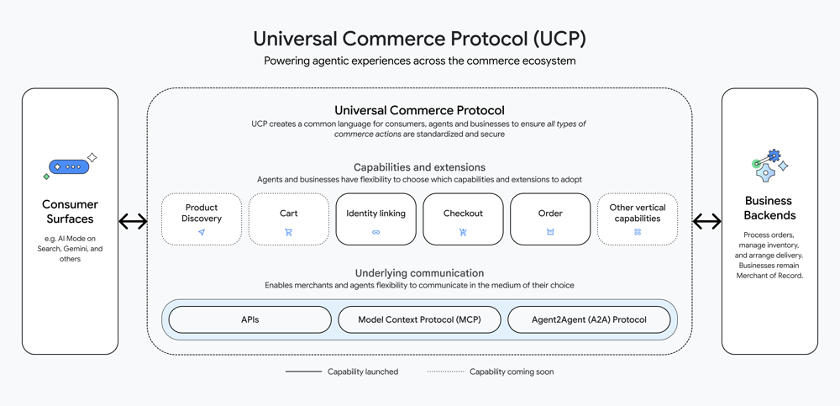
Illustration: UCP connects consumer-facing AI surfaces with business backends through standardized capabilities and protocols. Agents (on platforms like Google’s AI Mode or Gemini) dynamically discover what actions a merchant supports and use UCP’s uniform APIs (via REST, A2A, or MCP) to search products, add to cart, and checkout. Payments are handled via the Agent Payments Protocol (AP2), which passes tokenized payment credentials to the merchant’s chosen payment processor, while the merchant remains the record owner of the transaction.[7][27]
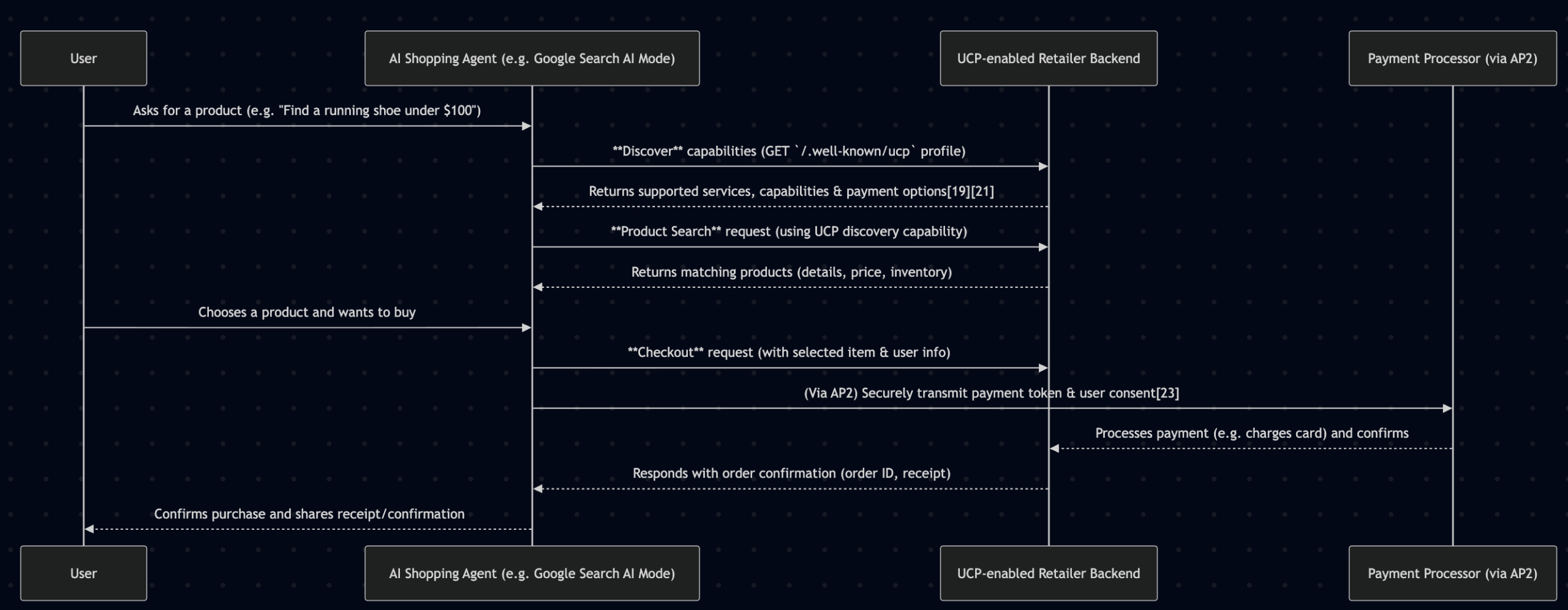
To make this more concrete, here’s a simplified example of a UCP-powered shopping flow from an AI assistant’s perspective:
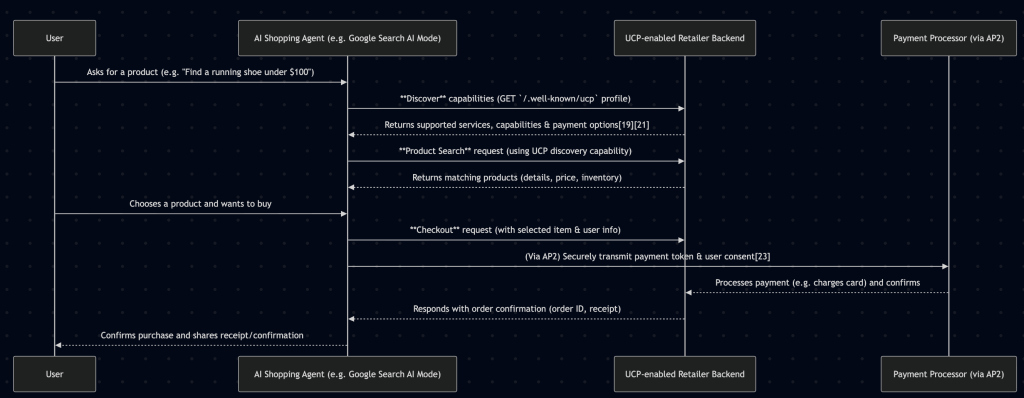
In this flow, the UCP abstraction layer handles much of the heavy lifting: the agent didn’t need custom code for this specific merchant, it learned how to search and checkout by reading the merchant’s UCP profile. The checkout happened natively within the AI interface (no web redirects), but the merchant stays in control of inventory, pricing, and fulfillment on their backend[27][28]. The payment was processed through a standard mechanism (AP2) that ensures the user’s approval was explicit and cryptographically verifiable, addressing the trust issues of AI-initiated transactions[24][25].
From a developer’s standpoint, UCP means if you’re building an AI shopping assistant, you can implement one set of UCP client methods (for discovery, search, checkout, etc.) and immediately be able to interact with any retailer that supports UCP. Conversely, a retailer can implement UCP once on their backend (either by using the open-source UCP SDK and sample servers Google has provided[29][30], or integrating it into their existing commerce APIs) and then be accessible to any AI agent that speaks UCP. This one-to-many integration pattern is what collapses the N×N integration problem of the past[31][32]. It’s akin to how adopting a standard like HTTP or SMTP allows broad communication – here UCP aims to do the same for commerce interactions across platforms.
Similar and Competing Approaches in AI Commerce
Google is not alone in pursuing standards or integrations for AI-driven commerce. A few notable parallel efforts include:
- OpenAI & Stripe’s Agentic Commerce Protocol (ACP): In late 2025, OpenAI introduced an “Instant Checkout” feature in ChatGPT, allowing users to buy products from within a chat conversation. This is built on an open standard called Agentic Commerce Protocol (ACP), co-developed by OpenAI and Stripe[33]. ACP (open-sourced under Apache 2.0) defines how AI agents, merchants, and payment providers communicate during a purchase, focusing on secure payment authorization and data exchange[34]. For example, ACP uses shared payment tokens so that ChatGPT can facilitate a purchase without exposing the user’s credit card details[34]. Importantly – like UCP – ACP ensures merchants remain the merchant-of-record and handle fulfillment, while the AI agent (ChatGPT) is just the interface connecting the user to the merchant[28]. This preserves the direct relationship between brands and customers. OpenAI’s first implementation was in partnership with Stripe and initially supported Etsy sellers, with plans to expand to Shopify merchants and other brands[35]. ACP and UCP share a similar ethos of being open standards for the “agentic economy” (where AI assistants transact on our behalf)[36]. It’s worth noting that AP2 (Agent Payments Protocol) – the payment layer of UCP – and OpenAI’s ACP both prioritize tokenized, user-consented payments, indicating a convergent solution to the problem of AI-initiated transaction trust.
- Shopify’s ChatGPT Integration: Shopify, as mentioned, is a launch partner in UCP – but it has also independently built a bridge into AI platforms. In September 2025, Shopify announced a direct integration with OpenAI’s ChatGPT, enabling Shopify’s millions of merchants to have their products listed and sold in ChatGPT conversations[37]. Shoppers can ask ChatGPT for a product recommendation (e.g. “What’s a good running shoe under $100?”) and get results pulled from Shopify’s real-time product data across merchants[38]. A user can then buy right within the chat, without any redirect to a website – ChatGPT essentially acts as a storefront. This is an example of “agentic commerce” in action[39]. On the backend, Shopify provides OpenAI with access to up-to-date inventory, pricing, images, etc., formatted for AI consumption. When a purchase happens, the order goes through Shopify’s system: the merchant’s store name is shown to the user, the order appears in the merchant’s Shopify admin, and the merchant remains the record owner of the sale[40]. Merchants can choose whether the checkout is handled instantly in-chat (an “Instant Checkout” experience powered likely by the Stripe/OpenAI payment flow) or handed off to their online store checkout if they prefer[40]. This integration is a more proprietary approach (specific to Shopify + OpenAI), but it aligns closely with the goals of UCP – namely, seamless conversational shopping and preserving the merchant’s brand and relationship with the customer. In fact, Shopify’s VP of Product noted this lets merchants “show up naturally” in AI discovery moments and sell without breaking the user’s flow[41].
- Other Ecosystem Efforts: Beyond Google and OpenAI, other players are also looking at AI and commerce. For instance, Walmart has been exploring both UCP (as a Google partner) and a partnership with OpenAI’s ChatGPT for shopping, essentially hedging bets across platforms[42]. Amazon, a dominant force in e-commerce, has its own Alexa voice assistant and shopping ecosystem, but so far Amazon has not announced an open protocol akin to UCP/ACP – likely because Amazon’s strategy is to keep users within its own platform. That said, the momentum of UCP and ACP suggests an industry trend toward standardizing retail APIs for AI agents. There have been earlier attempts at standardization in retail data (for example, schema.org’s product schemas for web SEO, or various commerce XML standards), but those addressed product data sharing rather than full transaction flows. UCP and ACP are novel in that they aim to standardize the transactional workflow (discovery through payment) across different ecosystems. It’s an ambitious goal – if these protocols gain traction, we could see AI-driven commerce become as interoperable as email or the web, where any assistant can interact with any store. This is why commentators have suggested that AI-native commerce could be the next major platform shift, collapsing the traditional search->click->buy process into a single conversational thread[43].
Implications for Google: Ecosystem Control, Search Relevance, and Partnerships
Google’s move with UCP carries significant strategic implications:
- Ecosystem Control: By spearheading an open yet Google-influenced standard, Google can position itself at the center of the AI commerce ecosystem. UCP is open-source and multi-partner, but Google’s leadership in developing it means the protocol naturally dovetails with Google’s platforms (Search AI, Android, Google Pay, etc.). If UCP is widely adopted, Google gains a degree of architecture control over how online transactions are executed via AI. This can be seen as a way to tie retailers more closely to Google’s orbit[44], ensuring that as agentic commerce grows, it grows in a way that isn’t bypassing Google. In practical terms, even though any agent could use UCP, Google is likely to integrate it deeply into its own services (Google Search, Assistant, Gemini AI), thus becoming a major gateway for UCP-based transactions. Owning that gateway confers leverage – Google can influence extensions to the standard, ensure its ad products or payment services are well integrated, and gather invaluable commerce data. It’s a form of ecosystem stewardship that also guards against the fragmentation of standards (and against rival proprietary networks dominating).
- Search Relevance in the AI Era: One big reason for UCP’s emergence is the threat that AI chatbots pose to traditional search and shopping paradigms. If users start turning to AI assistants (like ChatGPT, or Google’s own Bard/Gemini) to answer questions and make purchases, the classic search results page with ad links becomes less central. Google is adapting by embedding commerce directly into its AI search results – for example, adding “Buy” buttons in AI Mode and Gemini that use UCP to enable instant checkout[27]. This is a defensive and offensive play: defensively, it keeps users within Google’s experience for shopping (so they don’t defect to an AI that can complete transactions elsewhere), and offensively, it creates a new, smoother funnel for monetization. Rather than serving an ad that sends a user to a retailer’s site (hoping they purchase), Google can now facilitate the purchase right in search, potentially earning fees or at least keeping user attention. UCP thus helps make Google’s AI Search a one-stop-shop – research and buy in one place – which bolsters the continued relevance of Google in e-commerce. In the long run, if AI-driven shopping becomes common, having a robust infrastructure like UCP means Google Search can evolve from just finding information to executing transactions in partnership with retailers. This maintains Google’s centrality in the shopping journey at a time when pure informational search may be under pressure from conversational AI.
- Partnerships and Industry Alignment: UCP’s development and launch underscore a significant alignment between Google and major commerce players (Shopify, large retail chains, payment networks). Strategically, Google is presenting itself not as a competitor to retailers (contrast with Amazon, which many retailers see as both a marketplace and a rival), but as a collaborative platform provider. By ensuring that merchants remain the Merchant of Record and keeping their customer relationship direct[12][28], Google is addressing a chief concern businesses have about selling through third-party platforms. This approach helps Google court partners: Shopify’s involvement means millions of small merchants can come on board; big retailers like Walmart and Target see that they can participate without ceding control of their data or branding. The endorsements from payment companies (Visa, Mastercard, Stripe, etc.) further legitimize UCP and indicate that financial players want a say in the agentic commerce future[16]. For Google, these partnerships expand its reach and create a network effect – if many retailers and platforms speak UCP, it encourages others to join to remain accessible in AI contexts. It also places Google as somewhat of a neutral ground to unite against common competition. Notably, both UCP and OpenAI’s ACP are open standards with multiple backers, hinting at a coopetition dynamic: companies are willing to collaborate on infrastructure to ensure they aren’t left out individually. Google’s leadership with UCP thus strengthens its ties with the retail and payments ecosystem, giving it a collective force to counterbalance Amazon’s dominance and to negotiate the direction of commerce tech. As one analysis put it, UCP shows Google “positioning to capture transaction volume currently dominated by Amazon and Shopify’s native checkout systems”[45] – and doing so with the cooperation of Shopify and others rather than against them.
Conclusion
Google’s Universal Commerce Protocol is both a technical framework and a strategic statement about the future of shopping. Technically, it provides a unified, extensible way for AI agents and commerce systems to talk to each other – solving integration headaches and enabling truly seamless AI-assisted shopping experiences. Strategically, it ensures Google remains a central hub in the emerging agentic commerce landscape, by aligning with retailers and payment providers instead of disintermediating them. UCP and similar initiatives (like OpenAI’s ACP) suggest that commerce is entering a new era, one where conversational AI and commerce platforms converge through open protocols. For developers and businesses, now is the time to pay attention: adopting standards like UCP could soon be as important as having a mobile-friendly website was a decade ago. Google’s move signals that the lines between search, chat, and shopping are blurring – and Google intends to be the infrastructure that holds that future together[46][43]. The coming years will show whether UCP becomes the HTTP of AI commerce, but its launch marks a decisive step in integrating the AI revolution with the world of retail.
Sources: The analysis above is based on Google’s official announcement and developer documentation of UCP[3][7], commentary from industry reports on UCP’s launch[2][6], details from Shopify’s AI shopping partnership[47], and reports on OpenAI’s Agentic Commerce Protocol[33][28], among others. These sources provide further technical specifics and context on how UCP and similar protocols are shaping digital commerce.
[1] [3] [4] [5] [7] [9] [10] [11] [12] [13] [14] [17] [18] [19] [20] [21] [22] [23] [29] [30] [31] [32] Under the Hood: Universal Commerce Protocol (UCP) – Google Developers Blog
https://developers.googleblog.com/under-the-hood-universal-commerce-protocol-ucp
[2] [8] [42] [44] Google brings personalized discounts to AI search and launches open commerce protocol
[6] [15] [16] [27] [45] [46] Google & Walmart Deploy Universal Commerce Protocol at NRF
[24] [25] [26] AP2 – Agent Payments Protocol Documentation
[28] [33] [34] [35] [36] [43] OpenAI and Stripe Join Forces to Redefine Online Shopping with the Agentic Commerce Protocolrockbird media
[37] [38] [39] [40] [41] [47] Shopify and OpenAI bring commerce to ChatGPT

One Comment